
Six Workstreams for ISSB Implementation
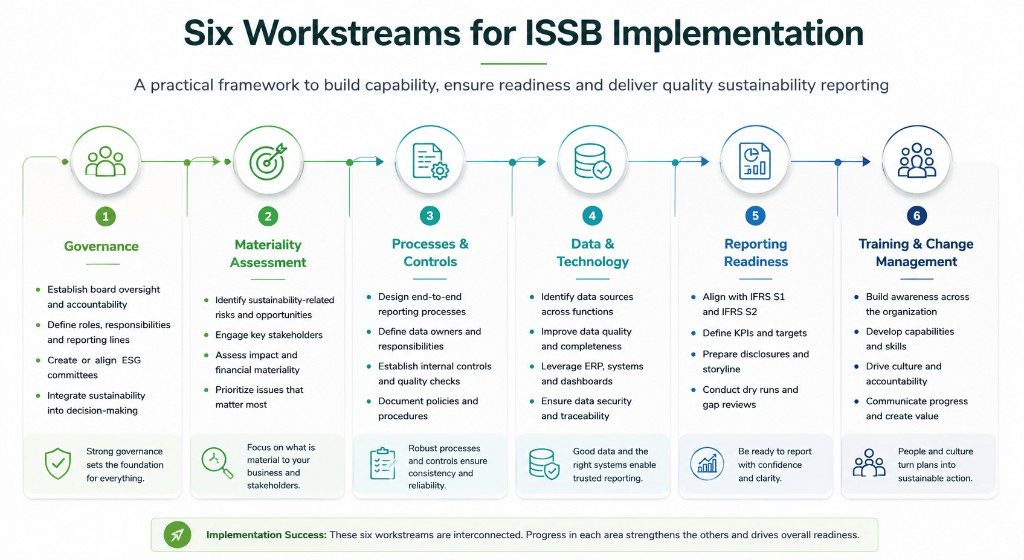
Figure 1. Six Workstreams for ISSB Implementation
A practical framework to build capability, ensure readiness and deliver quality sustainability reporting.
ISSB implementation succeeds when governance, materiality assessment, processes and controls, data and technology, reporting readiness, and training and change management advance together.
Source: Stratus Labs Executive Practice. Framework synthesized for ISSB / IFRS S1 and IFRS S2 reporting readiness advisory.
Companies often begin with a disclosure template and discover too late that ownership, data definitions and controls are missing. The six workstreams reverse that sequence. Governance and materiality set the scope. Processes and data make disclosures reliable. Reporting readiness and training convert plans into repeatable operating practice. Executives should treat the diagram as an integrated programme view rather than a menu of optional projects.
Sustainability reporting is no longer a voluntary narrative placed at the back of an annual report. Investors, lenders and business partners increasingly expect decision-useful information on sustainability-related risks, opportunities and climate exposure. Boards are being asked the same question they already ask of financial reporting: is the information reliable enough to support capital allocation and oversight?
In Pakistan, SECP sustainability reporting under ISSB standards is moving through a phased path. That path is helpful, but it should not create false comfort. Companies that wait for the final reporting cycle before building governance, data discipline and controls usually face rushed implementation, incomplete disclosures and higher remediation cost.
The International Sustainability Standards Board (ISSB) has set the global baseline through IFRS S1 and IFRS S2. For CEOs, CFOs, company secretaries and sustainability managers, the practical task is clear: establish ownership, decide what is material, collect ESG data with controls, and produce climate disclosure Pakistan leaders can defend.
ISSB readiness is a governance and operating challenge first. Disclosure quality follows ownership, evidence and control.
Why ISSB Matters for Pakistani Companies
Investor expectations are rising across public markets and private capital. Asset owners compare companies using more consistent sustainability information. Firms that cannot explain climate risk, sustainability strategy or key metrics may face higher scrutiny in fundraising, valuations and board discussions.
Lenders are also paying closer attention. Credit committees increasingly ask how environmental and social factors could affect cash flows, collateral and covenant risk. Clearer ESG reporting Pakistan prepares management to answer those questions with evidence rather than aspiration.
Export customers and multinational parents often require supplier or subsidiary information that aligns with group sustainability reporting. Pakistani companies in international value chains can find ISSB-aligned reporting readiness an operating requirement long before local timelines feel urgent.
Beyond external pressure, ISSB Pakistan preparation is a test of corporate governance Pakistan maturity. It forces leadership teams to clarify accountability, integrate climate risk into enterprise risk management and reduce reliance on informal spreadsheets for information that affects strategy and reputational risk.
In the longer term, disciplined disclosure supports competitiveness. Companies that understand sustainability risks and opportunities earlier can prioritise capital, suppliers and operating changes with less disruption. Sustainability consulting Pakistan work that focuses on operating readiness tends to create lasting capability.
The sections that follow turn those pressures into practical questions companies ask first: Am I affected? When do I need to comply? What should I start doing today?
Who Must Comply with ISSB Reporting in Pakistan?
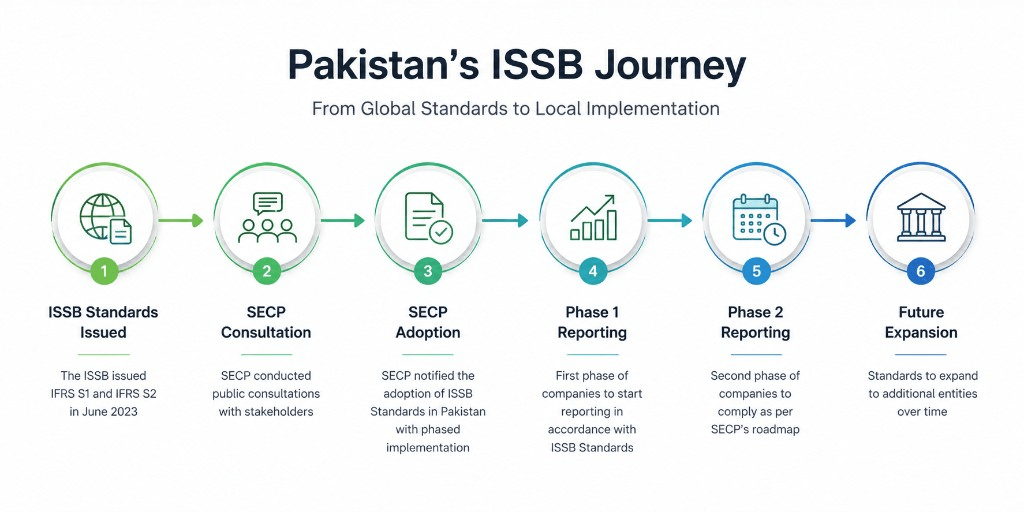
On 31 December 2024, the Securities and Exchange Commission of Pakistan (SECP) adopted IFRS S1 and IFRS S2 under Section 238 of the Companies Act, 2017. The order introduced a phased approach to sustainability reporting Pakistan for listed companies and certain SECP-regulated public interest companies.
Whether a company falls into an earlier or later cohort is determined using a 2-out-of-3 size threshold test based on turnover, assets and employees. Meeting any two of the three thresholds for a given phase brings the company into that SECP sustainability reporting cohort.
SECP ISSB Pakistan phases — 2-out-of-3 size threshold test for sustainability reporting
| Phase | Effective Date | Companies Covered | Turnover | Assets | Employees |
|---|---|---|---|---|---|
| Phase 1 | Reporting periods beginning on or after 1 July 2025 | Eligible listed companies meeting 2 of 3 | PKR 25 Billion | PKR 12.5 Billion | 1,000 |
| Phase 2 | Reporting periods beginning on or after 1 July 2026 | Eligible listed companies meeting 2 of 3 | PKR 12.5 Billion | PKR 6.25 Billion | 500 |
| Phase 3 | Reporting periods beginning on or after 1 July 2027 | Remaining listed companies and SECP public interest companies | See Phase 3 coverage note | See Phase 3 coverage note | See Phase 3 coverage note |
Phase 3 expands coverage further. From reporting periods beginning on or after 1 July 2027, remaining listed companies are brought into scope, together with public interest companies regulated by SECP. In practice, this includes entities such as insurance companies, asset management companies and other regulated organisations that fall within SECP’s public interest company definition.
The statute is only part of the picture. Many private companies will feel ISSB pressure earlier through markets, customers and capital relationships rather than through a direct listing obligation.
Why Many Private Companies Will Be Affected Earlier
Indirect applicability means market relationships can require ISSB-aligned ESG data before a legal filing obligation arrives.
Exporters
EU, UK and US customers increasingly request supplier ESG information and Scope 3 emissions data as part of procurement and onboarding.
Multinational Subsidiaries
Pakistani entities often must contribute sustainability data to global parent reporting packs under group ISSB or equivalent requirements.
Banking Relationships
Pakistani lenders are gradually strengthening ESG and climate risk assessment inside credit decisions, annual reviews and covenant discussions.
Supply Chains
Large listed companies will increasingly ask suppliers for sustainability information to support their own IFRS S1 and IFRS S2 disclosures.
Indirect applicability explains why sustainability information requests arrive before legal filing deadlines. Your largest relationships often set the real timetable.
Even if your company is not legally required to report today, your largest customer may require the same information tomorrow.
Understanding IFRS S1 and IFRS S2
IFRS S1 sets general requirements for sustainability-related financial disclosures. It asks companies to explain how sustainability-related risks and opportunities could affect prospects, and how those issues are governed, managed and measured under IFRS S1 Pakistan reporting expectations.
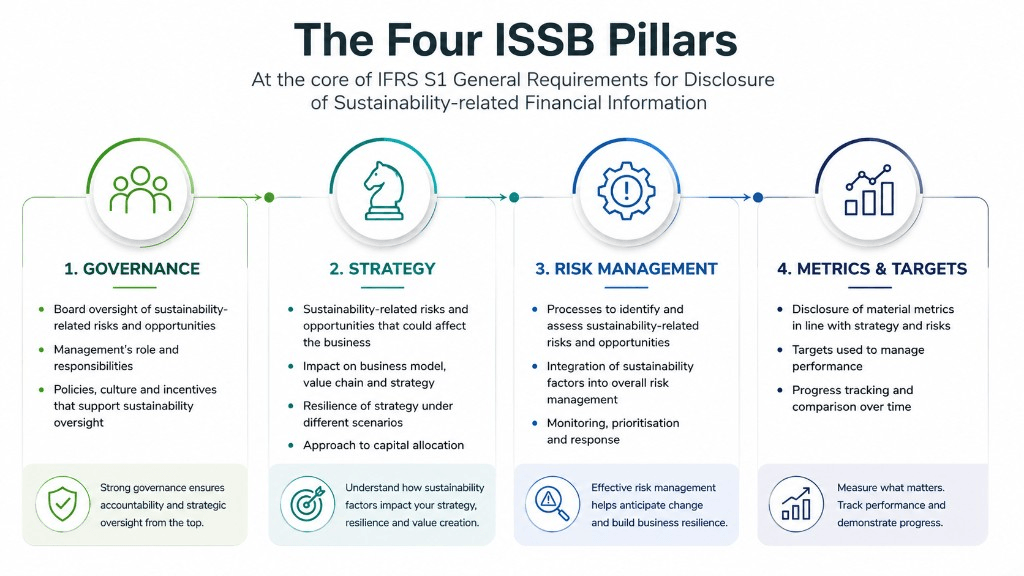
IFRS S1 is organised around four connected pillars: governance, strategy, risk management, and metrics and targets. Together, they move sustainability information from marketing copy into the discipline investors expect from financial reporting.
IFRS S2 focuses on climate-related disclosures. Under IFRS S2 Pakistan implementation, companies discuss climate risks and climate opportunities, including transition risks and physical risks, and explain effects on strategy and financial resilience.
IFRS S2 also covers scenario analysis, emissions information and the metrics and targets used to manage climate performance. IFRS S2 builds on IFRS S1, so climate disclosure sits inside the broader sustainability architecture rather than replacing it.
The four ISSB pillars give leadership a simple design test: who oversees sustainability risk, how strategy and capital plans respond, how risk processes escalate material issues, and which metrics prove progress over time.
Five Steps to Build ISSB Readiness
ISSB implementation is not an accounting close exercise alone. Year-end packaging matters, but readiness depends on cross-functional work among finance, strategy, risk, operations, procurement, HR, IT, legal and executive leadership.
The fastest way to build capability is a short, deliberate sequence. The five steps below convert SECP sustainability reporting obligations into an operating plan companies can execute this quarter.
Five practical steps
- 01
Leverage Year 1 Transition Reliefs
ISSB provides transitional reliefs that can allow climate-first focus, a one-year delay for Scope 3 greenhouse gas disclosures, and a longer reporting window in early periods. Use them to build capability, not to postpone ownership decisions.
- 02
Assign Governance
Clarify board ownership and the roles of the Audit Committee, Risk Committee, an executive steering group and a cross-functional working group. CFO, Operations, Legal, HR and IT should have explicit contributions to corporate governance Pakistan routines for sustainability reporting.
- 03
Perform a Financial Materiality Assessment
ISSB focuses on financial materiality: sustainability issues that could affect enterprise value, cash flows, financing or cost of capital. This differs from broader impact-only reporting. Sector guidance such as SASB can help identify relevant metrics.
- 04
Build Reliable ESG Data
Name data owners, evidence standards and controls. Reduce spreadsheet dependence where material metrics can be sourced through ERP and related systems. Strong ESG data discipline also prepares the organisation for external assurance expectations over time.
- 05
Run a Dry Run Before Go-Live
Complete one full mock reporting cycle before mandatory filing. Ask Internal Audit to identify missing controls, unsupported metrics, documentation gaps and governance weaknesses while remediation is still practical.
These five steps also strengthen the wider ISSB implementation workstreams covering governance, materiality assessment, processes and controls, data and technology, reporting readiness, and training.
Common Implementation Challenges
Most delayed programmes share familiar problems: unclear ownership, fragmented ESG data, inconsistent KPIs, undocumented processes, limited board oversight, manual spreadsheets, weak internal controls and uncertainty over materiality assessment.
These issues are manageable when leadership treats them as operating design problems. Assign owners, reduce metric sprawl, document processes, elevate corporate governance Pakistan reporting to the board, and replace informal files with controlled data flows.
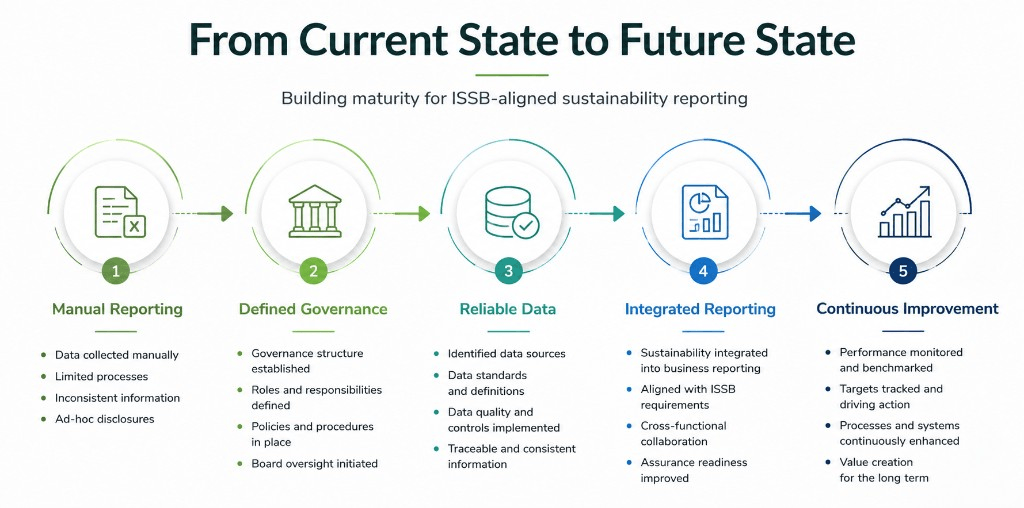
Maturity models help executives see the journey from ad-hoc disclosure to governed reporting. Moving from manual reporting toward defined governance, reliable ESG data, integrated reporting and continuous improvement is usually more realistic than attempting a one-step leap.
SECP Implementation Timeline
For companies asking when they need to comply, the SECP framework provides a clear calendar. Exact inclusion still depends on the size thresholds and entity classification, but the phase dates below set the planning horizon for ISSB Pakistan programmes.
Use the timeline to anchor board calendars, budget cycles and dry-run dates. Phase 1 entities should already be treating IFRS S1 and IFRS S2 as an active programme. Later cohorts should still start governance and data foundations early.
SECP ISSB implementation timeline
Phased sustainability reporting Pakistan timeline under SECP’s adoption of IFRS S1 and IFRS S2.
2025
Large listed companies (Phase 1)
2026
Mid-cap listed companies (Phase 2)
2027
Remaining listed companies & public interest companies (Phase 3)
Boards can ask a simple planning question: if our largest customer or lender requested ISSB-aligned information six months from now, could we produce it with controls we would stand behind?
Building ISSB Readiness Before Reporting Becomes Mandatory
Early preparation produces better sustainability reporting Pakistan outcomes and usually lowers total implementation cost. Teams that begin with governance, financial materiality and ESG data foundations avoid expensive year-end compression.
Companies starting today will be further ahead when SECP phases expand or when customers and investors ask harder questions about climate risk and sustainability strategy. ISSB readiness is cumulative: every controlled process and clarified owner reduces later effort.
The practical objective is straightforward. Build a reporting system Pakistani businesses can operate with confidence, aligned to IFRS S1 and IFRS S2, and strong enough to improve as standards, market expectations and SECP requirements evolve.
Executive insights
Board oversight question
Ask which sustainability and climate risks could affect capital plans, and who owns evidence quality for the answers presented to investors and lenders.
CFO starting point
Begin with ownership, materiality and a short list of metrics. Expanding data collection before definitions exist usually multiplies rework.
Climate disclosure risk
Transition and physical risk narratives without scenario logic or operational owners tend to fail the first serious investor review.
Readiness advantage
Companies that complete dry-run reporting early convert ISSB requirements into operating discipline instead of year-end crisis management.
Published August 7, 2026 · Updated August 7, 2026 · 8 min read
Related industries: Financial Services · Energy & Infrastructure
Related capabilities
Corporate Governance Consulting
Corporate governance consulting for boards and executives who need clearer decision rights, committee charters, board reporting and risk governance that keep pace with the business.
Strategy Consulting & Business Transformation
Strategy consulting for leadership teams that need clearer choices, a practical operating model and a transformation roadmap they can fund, govern and measure.
ERP Consulting & Implementation Advisory
ERP consulting for organizations selecting, implementing or recovering enterprise systems—with process ownership, data readiness and governance before capital and go-live decisions lock in.
PMO Consulting Services
PMO consulting for organizations that need programme management, portfolio governance and executive reporting that surface risk early and keep benefits honest.
Continue the Conversation
If your organization is navigating governance, ERP modernization or business transformation, our advisory team can help.