
The Modern HR System
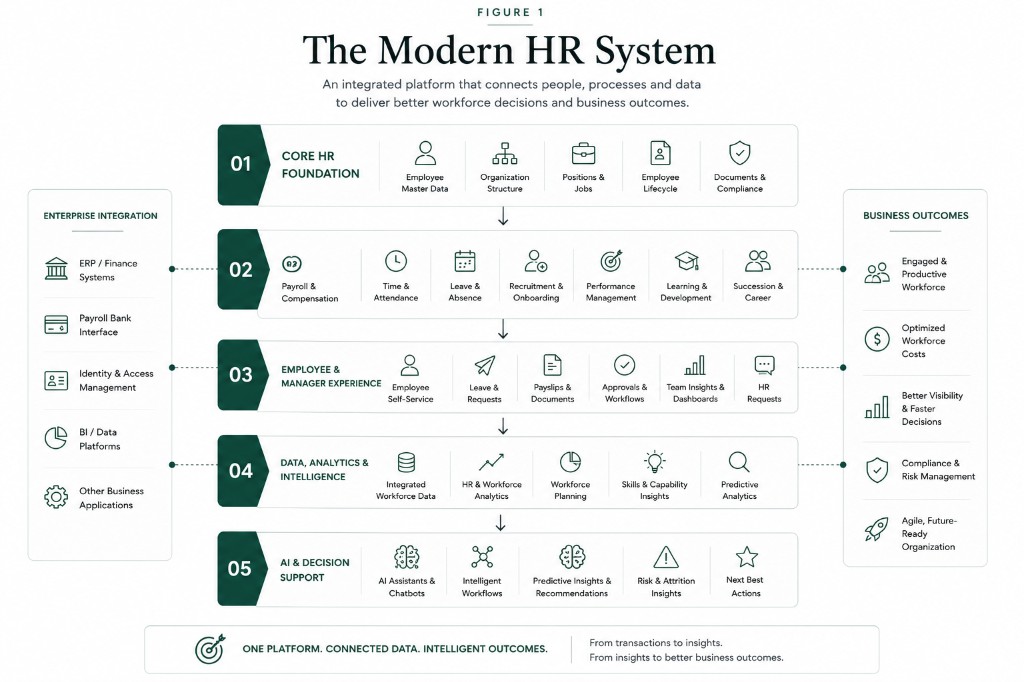
Figure 1. The Modern HR System
An integrated platform that connects people, processes and data to deliver better workforce decisions and business outcomes.
Core HR is the foundation. Operational modules, employee and manager experience, analytics and decision support only create value when employee data is consistent and connected to payroll, finance and other enterprise systems.
Source: Stratus Labs Executive Practice. Framework synthesized for HR technology and operating-model advisory.
The useful reading of this stack is architectural, not sequential shopping. Intelligence at the top cannot compensate for weak employee master data at the base. Self-service does not improve control unless workflows and policy are defined. Enterprise integration and business outcomes sit beside the platform because they are the reason to invest, not accessories to a licence. Leaders should ask which layer is currently the constraint—data, process, experience, reporting or integration—before adding another module.
Growing organizations often treat HR technology as a procurement exercise: compare vendors, watch a demonstration and sign a licence. The more important question is how HR processes, employee data, payroll, finance and management information should work together as the company scales. An HR system that cannot support that operating design will create work rather than remove it.
For growing businesses in Pakistan, and for organizations operating across multiple entities or locations, that question becomes more urgent as headcount, approvals and reporting complexity increase. Where HR, payroll and finance have developed as separate systems, leadership often cannot see workforce cost with confidence, and month-end reporting is reconstructed rather than produced.
The thesis of this article is straightforward. The right HR system should enable the organization's operating model rather than dictate it. HR system software can encode good process, protect a single source of employee truth and connect payroll to finance. It cannot invent an operating model the leadership team has not defined.
The right HR system should enable the organization's operating model rather than dictate it.
What a Modern HR System Should Actually Do
A modern HR management system is not a digital cabinet for employee files. It is the environment in which people data, organization structure, transactions and workforce decisions are created, controlled and reported. When that environment is coherent, HR, finance and line managers work from the same facts.
The foundation is core HR: employee master data, organization and position management, the employee lifecycle from hire to exit, and the documents and compliance records that travel with the person. Around that core sit the capabilities most companies eventually need: recruitment and onboarding, leave and workforce management, payroll and compensation, performance management, learning and development, employee self-service, workflow automation, and HR reporting and analytics.
Not every company needs every module immediately. The correct design depends on organizational size, process complexity, data maturity and which decisions leadership must make with confidence this year. What should not be deferred is architecture: employee records need a source of truth, processes that affect pay need defined workflows, and reporting needs consistent definitions. A cloud-based digital operating environment is often practical for growing companies because capability can be added without rebuilding the foundation.
What Are the Types of HR Systems?
Vendor language can obscure more than it clarifies. In practice, companies encounter several overlapping types of HR system. Core HR or HRIS typically covers employee records, organization structure and basic workforce administration. An HRMS usually extends that foundation into broader process modules such as leave, recruitment, performance or learning. HCM is often used for broader people platforms that also emphasize talent, skills and workforce planning. Integrated HR or ERP platforms place HR closer to finance, payroll and enterprise reporting. Specialized platforms focus on a narrower domain such as recruiting, learning or workforce scheduling. The practical distinction is scope and architecture: whether the system is the employee system of record, a broader people-process platform, part of an ERP landscape, or a specialist tool that must integrate cleanly.
These labels are not standardized. Two vendors may use different names for similar capability, or the same name for different depth. Companies should evaluate the processes, data model, integrations and reporting they need rather than selecting a system because it is branded HRIS, HRMS, HCM or ERP.
Start with the Business, Not the Software
Vendor demonstrations are a poor place to start. Before selecting HR system software, leadership should understand current HR processes, where they fail, who owns employee data, how approvals actually work, what reporting the business cannot produce, and how the future-state operating model should differ from today. That assessment should cover roles, data quality, payroll and finance integration requirements, and the few processes that must be standardized before they are automated.
Automating an inefficient process does not improve the process. It makes the exception path faster and harder to unwind. Organizations that skip this work often select a system that fits a demonstration script rather than the way the company needs to run.
Automating an inefficient process does not improve the process. It makes the exception path faster and harder to unwind.
How HR Technology Should Connect the Business
HR, payroll, finance and ERP are one information chain. Employee data should feed payroll. Payroll should feed accounting. Workforce and cost data should feed management reporting. When those links are informal, the organization pays in duplicate data, manual reconciliation, inconsistent employee information, payroll errors, reporting delays and weak controls.
Integration is therefore a business architecture issue, not an optional IT feature. It determines whether finance can trust workforce cost, whether HR and payroll share one employee record, and whether leadership can answer basic questions on headcount and cost without assembling spreadsheets. ERP and core systems advisory belongs in this conversation whenever HR sits inside a wider enterprise landscape.
Where attendance, payroll and accounting run as disconnected tools, each hand-off becomes a control gap and an administrative cost. An HR system with payroll integration, or a designed interface between the HR system, payroll and accounting software, is how that cost is removed.
How to Choose an HR System
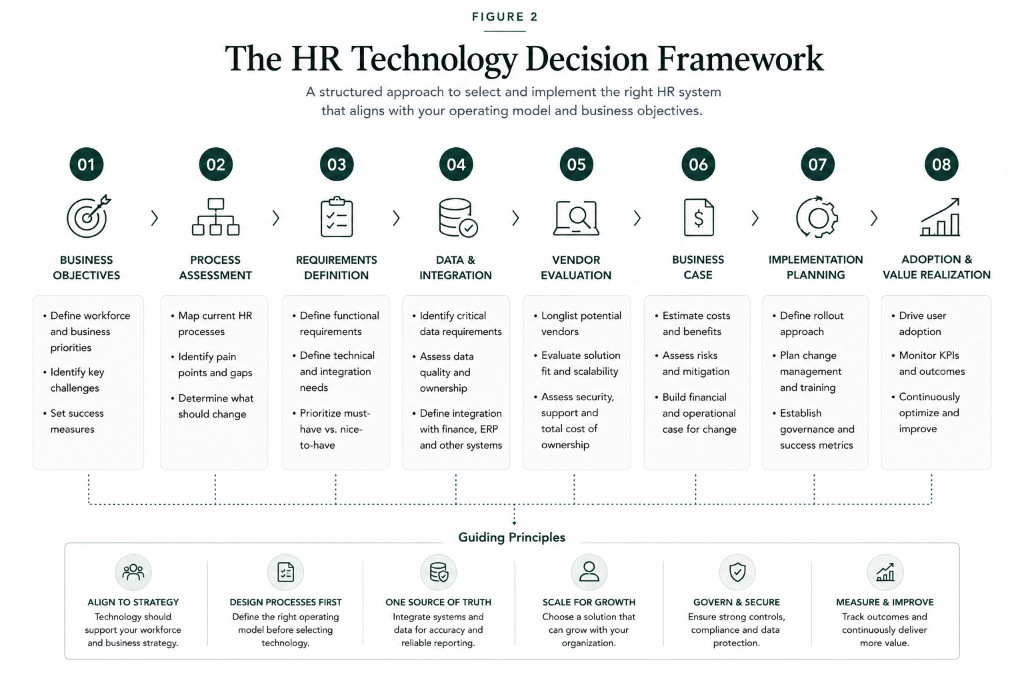
The decision framework is useful because it prevents a common inversion: starting at vendor evaluation. Business objectives, process assessment, requirements and data design should constrain the longlist. Choosing an HR system is an evaluation of operating fit. Leadership should test real scenarios: a new hire that must appear correctly in payroll, a transfer across cost centres, a leave request that affects the next pay cycle, a manager approval, a month-end workforce cost report, and an audit trail that finance would accept.
Licence price is only one part of the decision. Companies should compare total cost of ownership: licences, implementation, integration, data migration, customization, training, support and ongoing administration. A lower licence fee that requires heavy customization, weak integration or an inexperienced implementation team is rarely cheaper over the life of the system. Include the internal cost of maintaining workarounds if integration and data quality are left unresolved.
A software demonstration is not evidence. Vendors will show the happy path. Companies should insist on their own workflows, their accounting environment and their control requirements. Implementation partner capability matters as much as the product, because configuration, data migration and change will determine whether the HR system is used.
Build, Buy or Integrate?
Architecture choice is not only which product to buy. Some organizations should buy a standard platform and adopt its process model. Others should configure an existing platform where the fit is close. Where HR, payroll and finance already have durable systems, integration may be the better design. Custom functionality should be reserved for a small number of genuinely distinctive requirements. Do not build simply because customization is possible, and do not buy a complete suite when integration is the better architecture.
HR Systems for Small and Growing Businesses
Growing companies looking for an HR system for small businesses, or for HR software in Pakistan, are often advised to buy a thinner product. The more accurate view is that they need the right capabilities without unnecessary complexity. A smaller company does not necessarily need fewer capabilities. It needs fewer exceptions and a system it can adopt.
A smaller company does not necessarily need fewer capabilities. It needs fewer exceptions and a system it can adopt.
Priorities typically include core HR, payroll, leave, workforce management, employee self-service, reporting, cloud accessibility, integration, ease of implementation, scalability and cost transparency. A cloud-based HR system that can add modules as process discipline grows is usually more valuable than a heavily customized suite the organization cannot operate.
Payroll and Accounting Integration
The practical chain is employee data, then payroll, then accounting, then management reporting. When that chain is designed, workforce cost becomes visible, payroll controls improve, reconciliation shortens, audit trails exist, and planning uses the same numbers finance already trusts.
When it is not designed, HR and finance spend each month reconstructing headcount and cost. Selecting an HR system that integrates with accounting software is therefore a finance control decision as much as an HR one. Automated HR processes remain trustworthy only when pay and books move from the same employee record.
Considerations for Pakistani Businesses
For growing businesses in Pakistan, several practical considerations usually shape the architecture. Payroll and finance integration should be explicit: whether the HR system owns payroll, sits beside an existing payroll engine, or replaces both as a connected design. Organizational structures, cost centres and multiple entities or locations need a clear data model. Localization and configuration should support the company's payroll, leave and reporting requirements without fragile customization. Implementation support and a path to scale matter as much as the feature list.
Employee Self-Service and Automation
Modern HR systems allow employees and managers to complete routine work: leave requests, personal information, documents, payroll information, approvals and HR requests. That is not only a convenience layer. It is how organizations reduce HR as a bottleneck without losing control of policy.
Automation should reduce friction and improve control. A well-designed workflow records who approved what, applies policy consistently and leaves an evidence trail. A poorly designed portal simply relocates the same informal exceptions.
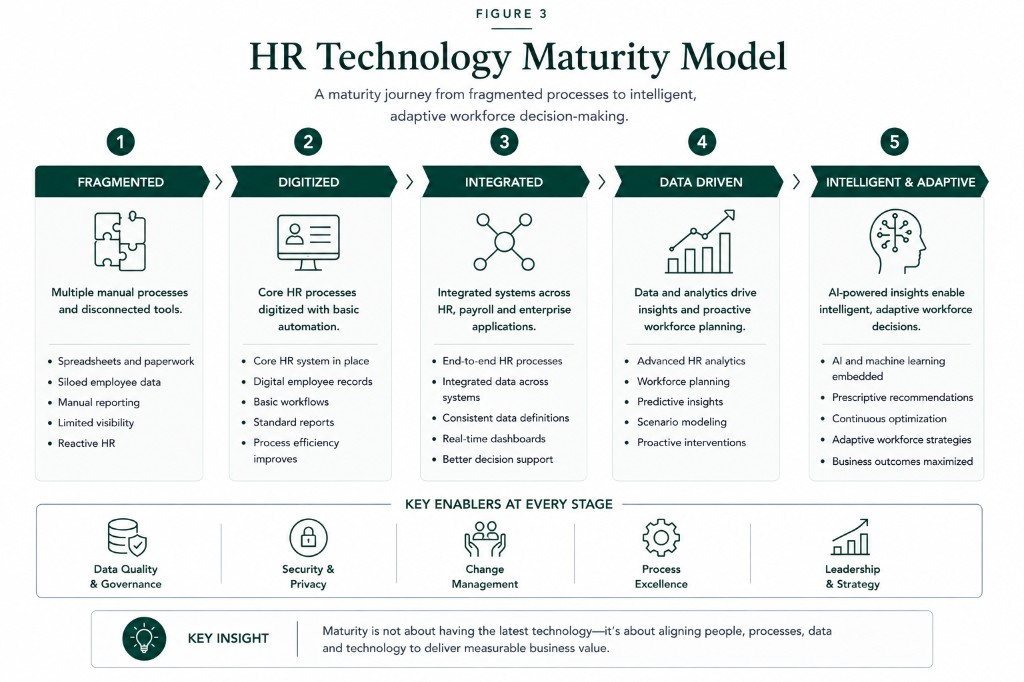
The objective of HR employee self-service is a cleaner operating rhythm: fewer emails, fewer shadow spreadsheets, faster cycle times and better data because the people closest to the facts enter them once. How far an organization can progress from fragmented administration toward a more mature HR environment depends less on buying the latest module than on data quality, process discipline and leadership.
Where Does AI Fit Into the Modern HR System?
AI can strengthen a modern HR system once the foundation is reliable. Practical uses include HR knowledge assistants, answers to common employee queries, document generation, workforce analytics, skills analysis, workforce planning support and learning recommendations. AI should build on reliable workforce data and defined processes. The closer AI gets to consequential employment decisions, the stronger human oversight and governance should be. Used well, AI reduces administrative load and improves insight. Used poorly, it accelerates decisions on incomplete or poorly governed workforce data.
HR Technology Implementation
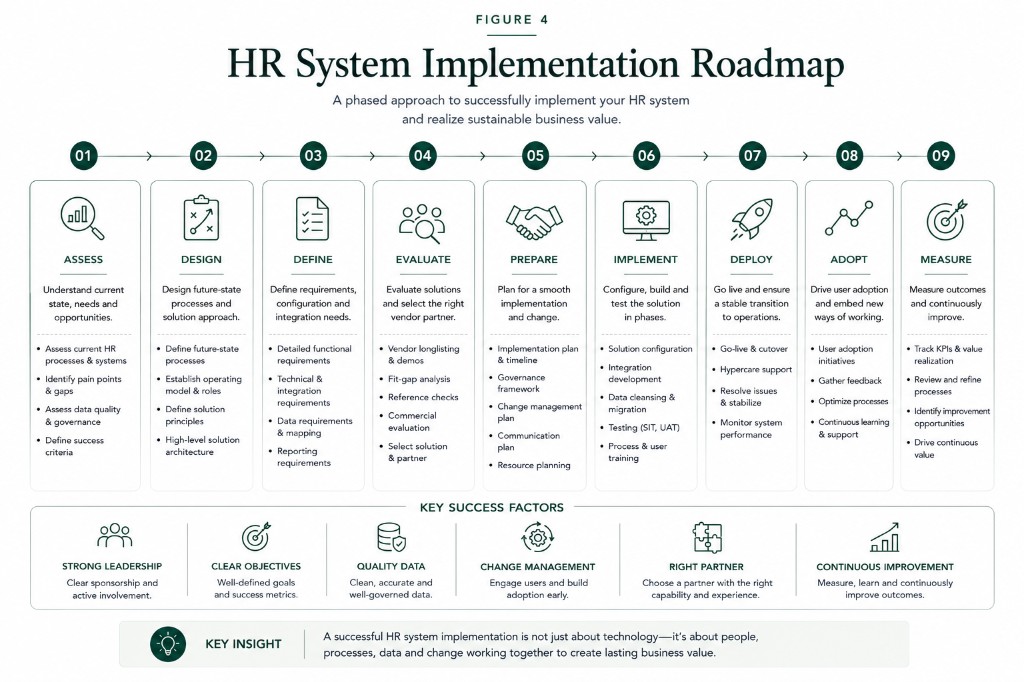
Software selection is visible. HR system implementation is where value is won or lost. Leadership ownership, requirements, data cleansing, configuration, integration, testing, training, change, go-live, support, adoption and measurement determine whether the system becomes the way the company works.
Implementation should be connected to business outcomes from the start: fewer payroll exceptions, faster onboarding, reliable headcount, managers who can approve without chasing HR, and finance that can close workforce cost without reconstruction. Training and adoption are part of the design, not a final slide. Managers need to approve in the system, exceptions need a designed path, and programme and PMO support helps keep delivery connected to those outcomes. Assess, design, define, evaluate, prepare, implement, deploy, adopt and measure are a sequence: skipping a stage usually moves unresolved design into go-live.
What Good Looks Like
A mature HR technology environment is recognizable in the operating rhythm, not in the number of modules switched on. Employee data has a clear source of truth. Processes that affect pay and reporting are standardized. Payroll and finance are connected. Management has reliable workforce information. Employees can complete appropriate self-service. Access controls are defined. The HR system supports the operating model, and business value is measured after go-live.
Frequently Asked Questions
The questions below are the ones leadership teams typically ask first when an HR system decision is approaching.
Frequently asked questions
- 01
What is an HR management system?
An HR management system is the operating environment for employee records, people processes, workflows and workforce information. In a modern design it connects core HR, payroll, self-service and reporting so the organization works from one source of employee truth.
- 02
What are the types of HR systems?
Common labels include Core HR or HRIS, HRMS, HCM, integrated HR or ERP platforms, and specialized tools for recruiting, learning or scheduling. Vendor terminology varies. Evaluate capabilities, data model, integration and reporting rather than selecting a label.
- 03
What modules should an HR system have?
Start with core employee records, organization and position data, leave, payroll, self-service, workflows and reporting. Add recruitment, performance and learning when the operating model can use them. Module count should follow priority, not a vendor catalogue.
- 04
How do I choose an HR system for a growing company?
Define the future-state processes, data and integrations first. Then test vendors against real scenarios such as hire-to-pay, approvals, month-end reporting and the accounting hand-off. Weigh total cost of ownership and implementation capability equally with product fit.
- 05
What is the best HR software in Pakistan?
There is no single best HR software in Pakistan. Suitability depends on company size, processes, payroll design, finance integration, reporting needs, scalability, implementation capability and total cost of ownership.
- 06
Should an HR system integrate with accounting software?
Yes, if workforce cost, payroll controls and management reporting matter. Employee data should feed payroll, and payroll should feed accounting, with clear ownership and an audit trail. Integration is a control design, not a technical extra.
- 07
What makes an HR system implementation successful?
Leadership ownership, clean data, configuration that matches standardized processes, tested integrations, training, change management, and measurement after go-live. The software demonstration is not the implementation.
Growing companies in Pakistan do not need the most elaborate HR platform. They need an HR system that matches how they intend to operate, connects people data to payroll and finance, and is implemented with enough discipline that people use it. Start with the operating model. Select technology second. Measure value after go-live.
Executive insights
Start with the operating model
Decide how HR, payroll and finance should work together before a vendor is invited to demonstrate software.
Standardize before you automate
Encode the processes you intend to run. Automating exceptions usually recreates fragmentation at higher cost.
Treat integration as control design
If employee data, payroll and accounting do not share a designed path, workforce cost and reporting will remain reconstructed.
Own adoption after go-live
Configuration alone is not value. Value appears when managers use the system, data stays clean and workforce information is trusted.
Measure the operating change
Track payroll exceptions, onboarding cycle time, reporting effort and manager self-sufficiency. That is how an HR system proves it created business value.
Published August 13, 2026 · Updated August 13, 2026 · 10 min read
Related industries: Technology · Healthcare · Education & Real Assets
Related capabilities
Digital Transformation Consulting
Digital transformation consulting for organizations modernizing platforms, enterprise architecture and operating processes without losing business control or creating new complexity.
ERP Consulting & Implementation Advisory
ERP consulting for organizations selecting, implementing or recovering enterprise systems—with process ownership, data readiness and governance before capital and go-live decisions lock in.
PMO Consulting Services
PMO consulting for organizations that need programme management, portfolio governance and executive reporting that surface risk early and keep benefits honest.
Strategy Consulting & Business Transformation
Strategy consulting for leadership teams that need clearer choices, a practical operating model and a transformation roadmap they can fund, govern and measure.
Continue the Conversation
If your organization is navigating governance, ERP modernization or business transformation, our advisory team can help.